


Clinical Capacity & Schedule Integrity: What the Schedule Does Not Show
The Schedule Is Only Part of the Workload
Healthcare organizations rely heavily on appointment schedules to understand clinical capacity.
A schedule provides visibility into booked visits, available appointment slots, and provider utilization. These are important operational measures.
But the schedule does not represent the entirety of clinical work.
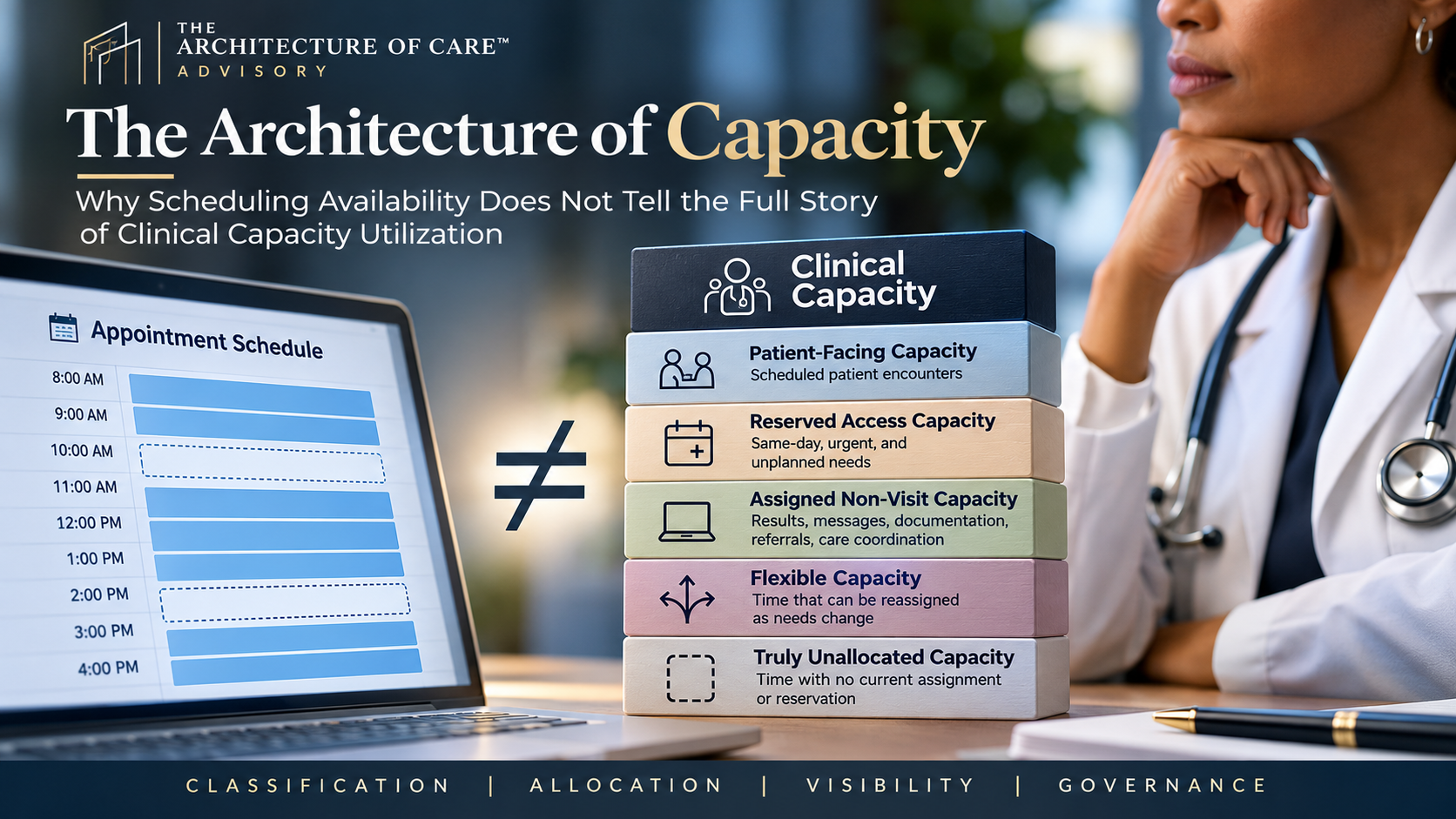
Between appointments, clinicians and care teams manage diagnostic results, patient messages, medication requests, referrals, documentation, and coordination across services.
Some of this work is predictable. Much of it arrives asynchronously, requires clinical judgment, or depends on information held elsewhere in the organization.
When organizations evaluate capacity primarily through scheduled encounters, they risk overlooking the work required to make those encounters clinically meaningful and operationally complete.
Schedule utilization is not the same as clinical capacity.
The Structural Sources of Capacity Pressure
Clinical capacity is shaped by more than the number of appointments assigned to a clinician.
It is influenced by the distribution of responsibilities, the timing of incoming work, the reliability of support processes, and the frequency of interruptions.
Consider an ambulatory team operating at full appointment utilization.
A clinician may also be responsible for an expanding volume of electronic messages, unresolved referrals, diagnostic follow-up, and cross-coverage responsibilities.
If these responsibilities are not represented within the operating model, the schedule may appear efficient while the actual workload becomes increasingly fragmented.
The underlying problem is not necessarily individual productivity.
It may be a mismatch between assigned work, available time, and the operational resources required for completion.

Capacity Requires Workflow Integrity
Capacity analysis should examine how clinical responsibilities move through the system.
Within The Architecture of Care™, five interconnected dimensions provide a useful diagnostic lens:
Time: When does work arrive, and when can it realistically be completed?
Ownership: Who has responsibility for each clinical or operational action?
Continuity: What happens when responsibilities extend beyond an individual encounter?
Information Flow: Does the person responsible have the information required to act?
Throughput: How does work progress from initiation to appropriate resolution?
These dimensions interact.
An unclear handoff can create delays. Incomplete information can increase task duration. Repeated interruptions can reduce the capacity available for complex decision-making.
Examining these relationships reveals pressures that appointment counts alone cannot explain.
“The schedule tells us how time has been allocated. Workflow integrity tells us whether that allocation is operationally sustainable.”
Moving Beyond Utilization Metrics
A more complete capacity assessment examines both visible and less visible work.
Leadership should understand the volume and complexity of asynchronous tasks, the time allocated to them, and the operational pathways through which they are completed.
Equally important is identifying work that repeatedly returns to the same clinician because ownership, information, or follow-through was incomplete elsewhere.
This requires examining the operating system rather than treating every capacity concern as an individual performance problem.
The objective is not to eliminate productivity measures.
It is to interpret those measures within the broader conditions that produce clinical work.
Designing Sustainable Clinical Capacity
Sustainable capacity depends on the alignment of clinical demand, workforce responsibilities, scheduling structures, and operational support.
Increasing appointment availability without examining the surrounding workflow can redistribute pressure rather than resolve it.
A stronger approach begins by identifying where work is generated, how responsibility is assigned, and which dependencies influence completion.
From there, leaders can make more informed decisions about scheduling, staffing, workflow redesign, and the use of technology.
Clinical capacity should ultimately reflect an organization's ability to deliver reliable care—not simply the number of appointments it can place on a calendar.
The schedule tells us how time has been allocated. Workflow integrity tells us whether that allocation is operationally sustainable.


Whether the concern involves fragmented workflows, unclear accountability, constrained clinical capacity, or unreliable coordination, the starting point is a clear understanding of the operating conditions involved.
An initial executive conversation provides an opportunity to discuss the organizational challenge, relevant priorities, and whether a structured architectural assessment would be appropriate.