


THE ARCHITECTURE OF PRIORITY
Why Competing Clinical Demands Require Clear Decision Rights and Operational Accountability
The Architecture of Care™ | Executive Insights | Part 2
When Everything Is Important, What Comes First?
A clinician begins the day with scheduled appointments, diagnostic results requiring review, patient messages awaiting responses, documentation, and responsibilities related to care coordination and population health.
Each activity serves a legitimate purpose. Each contributes to some aspect of patient care, operational performance, or organizational accountability.
But what happens when several require attention at the same time?
Healthcare organizations routinely establish expectations for access, productivity, quality, documentation, continuity, and responsiveness. These expectations may be reasonable when considered individually. Collectively, however, they draw upon the same limited workforce capacity.
The challenge is not simply the volume of work. It is determining which responsibilities take precedence when they cannot all be completed as originally planned.
Clinicians make prioritization decisions throughout the day. Professional judgment is essential when patient conditions change or time-sensitive clinical needs arise.
But some conflicts extend beyond clinical judgment.
When additional population health responsibilities compete with previously assigned administrative work, or when increased appointment demand reduces the time available for diagnostic follow-up, the decision involves organizational commitments and resource allocation.
Those decisions require clearly established authority.
Without it, clinicians and care teams may be expected to reconcile priorities that different organizational functions established independently.
The result can be a gap between what the organization expects and what its operating arrangements make possible.
The importance of a responsibility does not automatically establish its priority relative to competing work.
Effective priority management requires more than communicating expectations. It requires decisions about precedence, capacity, authority, and what happens when existing responsibilities must be displaced.
Clinical Urgency and Organizational Priority Are Not the Same
Clinical urgency and organizational priority both influence how healthcare work is performed, but they are not interchangeable.
Clinical urgency is determined by the patient's condition, the potential consequences of delay, and appropriate professional judgment.
A critical diagnostic finding may require immediate intervention. A patient reporting concerning symptoms may need prompt assessment. Other clinical concerns can appropriately be addressed within established follow-up periods.
These decisions depend on clinical risk and applicable standards of care.
Organizational priorities, by contrast, reflect institutional commitments concerning patient access, quality improvement, documentation, productivity, regulatory compliance, financial sustainability, and population health.
These are legitimate responsibilities. Appointment access affects patients' ability to obtain care. Timely documentation supports communication and continuity. Population health initiatives can improve the identification and management of preventive and chronic care needs.
However, organizational importance does not automatically establish immediate precedence.
A quality initiative may be strategically important without requiring attention ahead of a time-sensitive patient concern. Conversely, an organizational obligation may carry a mandatory deadline or clinical safety implications that limit the discretion available to defer it.
The distinction is therefore not between important clinical work and unimportant administrative work.
It is between different forms of responsibility, with different consequences, timeframes, and decision requirements.
The challenge emerges where they intersect.
When an urgent clinical concern redirects a clinician's attention, other assigned work remains. Appointments may be affected, documentation may be delayed, and responsibilities may require reassignment.
The immediate clinical decision may be clear. The operational consequences may not be.
A reliable operating model must preserve appropriate professional judgment while establishing how competing organizational commitments will be managed.
Clinical urgency requires professional judgment. Organizational priority requires defined leadership decisions about competing work, available capacity, and acceptable tradeoffs.
The Problem of Competing Workstreams
Healthcare organizations manage clinical work through multiple processes and information systems.
Scheduling systems track appointments. Electronic health records display messages, results, and documentation. Quality dashboards report performance measures. Care coordination processes manage referrals and follow-up responsibilities.
These systems provide visibility into individual categories of work.
They do not necessarily establish whether the combined responsibilities can be completed within the capacity available to the people assigned to perform them.
This distinction matters.
A clinician's appointment schedule may appear manageable while additional responsibilities remain distributed across several work queues. A population health initiative may introduce new expectations without reducing existing obligations. Documentation deadlines may remain unchanged even as clinical demand increases.
Each workstream may be functioning according to its own requirements while the combined workload becomes increasingly difficult to reconcile.
Research on healthcare work systems supports examining performance in relation to the interaction of people, tasks, technologies, organizational arrangements, and the environment in which work occurs. The SEIPS framework described by Carayon and colleagues provides one established foundation for this systems-oriented analysis.
The implications for priority management are substantial.
Organizations cannot assess workload feasibility solely by reviewing individual targets or visible appointment availability. They must consider the cumulative demands placed on shared clinical resources.
When commitments accumulate
Additional responsibilities are often introduced through separate organizational decisions.
A quality initiative may establish new documentation requirements. An access strategy may increase appointment availability. A population health program may assign additional follow-up activities.
Each initiative may have a reasonable justification.
But its implementation may not include an explicit decision about which existing responsibility will receive less time, additional support, or a revised expectation.
Over time, commitments can accumulate without an equivalent adjustment to capacity.
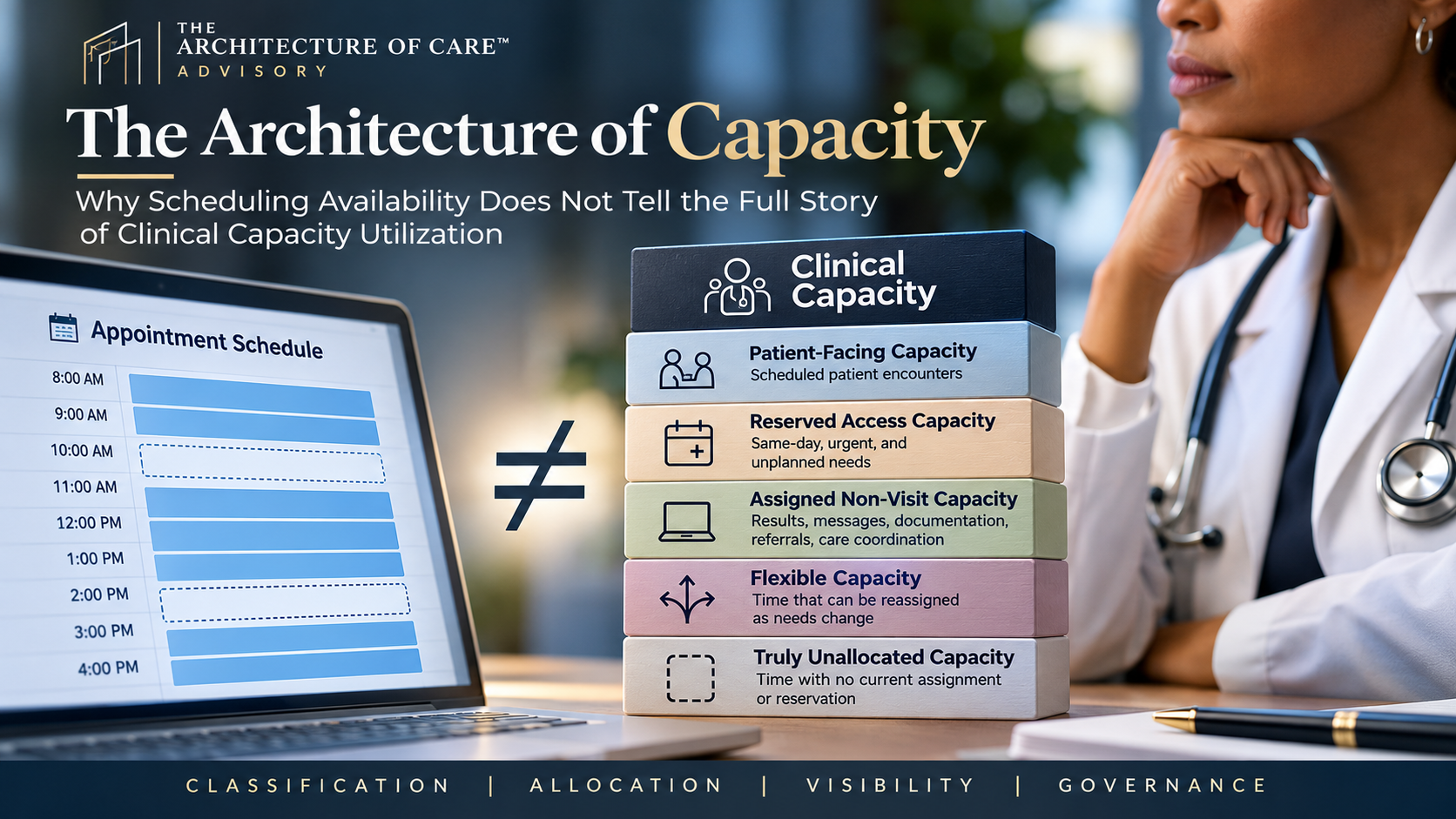
In The Architecture of Capacity, we examined why scheduling availability does not necessarily represent unused clinical time.
That distinction applies directly here.
Capacity concerns the resources available to perform work. Priority concerns how those resources are allocated when legitimate demands compete.
The two cannot be managed independently.
Repeated interruptions, transitions between tasks, and unresolved work queues can further complicate performance. Research on clinical interruptions demonstrates that the consequences of disrupted work deserve attention, although findings from particular clinical settings should not be generalized indiscriminately to every outpatient activity.
The leadership question is whether competing responsibilities are coordinated across the operating model or managed separately until conflicts emerge at the frontline.
Adding responsibilities without defining what they displace does not create additional capacity.
Priority Allocation Is a Leadership Decision
Organizational priorities are established at different levels.
Clinical leadership defines expectations for patient safety and care delivery. Operations leaders establish access and productivity objectives. Quality functions develop improvement initiatives. Compliance teams establish mandatory requirements.
Each function has a legitimate purpose.
Yet these expectations ultimately converge within the work performed by clinicians and care teams.
When they compete, who has authority to resolve the conflict?
This question should not be confused with whether clinicians are capable of organizing their work.
Frontline discretion remains essential. Clinicians must assess clinical urgency, act within professional standards, and organize assigned responsibilities appropriately. Care teams require flexibility to coordinate routine activities and respond to changing patient needs.
But discretion over task sequencing is not the same as authority to change organizational commitments.
A clinician may determine that an urgent result requires immediate attention without having authority to change an appointment template, revise a department-wide deadline, or modify a performance target.
Similarly, a team may identify insufficient capacity without having authority to change staffing allocations or eliminate assigned responsibilities.
These decisions belong to management structures with the appropriate scope of control.
Four questions should therefore be answered within the operating model:
- Who establishes precedence when organizational responsibilities compete?
- Who may change assignments, deadlines, or workload expectations?
- Which decisions belong to frontline clinical and team discretion?
- Who resolves conflicts that exceed local authority?
The objective is not to centralize routine decisions.
It is to place decisions at the level where the necessary authority exists.
When a conflict requires action across departments, an escalation process must be capable of producing a resolution rather than returning the same incompatible expectations to the people performing the work.
Responsibility and authority must also be distinguished when evaluating performance.
Clinicians remain accountable for appropriate action, communication, and escalation. Managers remain accountable for coordinating work and addressing constraints within their authority. Executive leadership remains accountable for the organizational arrangements through which competing commitments are established and reconciled.
An organization cannot delegate responsibility for meeting competing expectations without also defining the authority to resolve conflicts between them.
When Priorities Change, What Happens to the Work That Is Displaced?
Healthcare delivery requires flexibility.
Patient conditions change, unexpected events occur, and operational demands fluctuate. Reprioritization is necessary.
But selecting one responsibility over another does not eliminate the work that must wait.
A priority change is therefore incomplete until its consequences for other responsibilities have been addressed.
Displaced work generally requires one of several responses.
Deferral may be appropriate when the consequences of delay are acceptable. The decision should establish a suitable completion timeframe and continuing responsibility.
Reassignment may be necessary when the original owner cannot complete the work. The transfer should identify an appropriately qualified receiving party, provide necessary information, and establish who is responsible for the next action.
Revised deadlines may be appropriate when operational expectations can legitimately change. Clinical, legal, regulatory, and contractual requirements must still be respected.
Escalation is required when the responsibility cannot safely be deferred or when the necessary adjustment exceeds frontline authority.
These are not merely administrative distinctions.
They affect whether responsibilities remain visible and whether necessary actions reach completion.
A diagnostic result may be reviewed without the required follow-up being completed. A referral may be initiated without the next step occurring. A message may move between queues without a clear owner accepting responsibility.
The movement of information is not necessarily the completion of work.
Nor does forwarding a responsibility automatically establish a successful transfer of accountability.
A reliable operating model must therefore distinguish task routing from ownership and activity from completion.
Appropriate tracking should continue until the responsibility reaches its intended endpoint or another authorized disposition.
This does not require excessive documentation of every routine adjustment. Established protocols can support routine decisions, while higher-risk or unresolved conflicts require more formal escalation.
The governing principle remains straightforward:
Changing what comes first does not eliminate what still needs to be done.
A priority decision must account for the work it displaces, the authority required to manage it, and the process through which its completion will be confirmed.
The Accountability Problem: Prospective Priorities Versus Retrospective Judgment
Healthcare organizations require meaningful performance accountability.
Clinicians and care teams must meet professional standards, fulfill assigned responsibilities, communicate barriers, and respond appropriately when expectations are not met.
But evaluating performance requires more than determining whether an individual target was achieved.
It also requires understanding the expectations and operating conditions under which the work occurred.
A clinician may be evaluated for appointment productivity, documentation timeliness, diagnostic follow-up, and population health performance.
Each measure may provide useful information.
Yet the activities contributing to those measures may compete for the same available time.
A shortfall in one area does not, by itself, establish why the result occurred.
It may reflect a failure to follow established procedures, an individual performance deficiency, insufficient capacity, a change in clinical demand, or an unresolved conflict between organizational priorities.
These explanations are not mutually exclusive.
Human-factors and patient-safety scholarship, including Reason's work on human error and system conditions, supports examining how individual actions interact with the circumstances in which work is performed.
The executive implication is not that individual accountability should be diminished.
It is that performance conclusions should be matched to the causes established through review.
The problem with retrospective expectations
Performance evaluation becomes particularly difficult when leadership determines after the fact which competing responsibility should have taken precedence.
An employee may have prioritized one legitimate assignment while another remained incomplete.
If the organization previously established clear precedence rules, appropriate resources, and required escalation procedures, the review can examine whether those expectations were followed.
If those arrangements were never established, the review faces a different question.
Was the responsibility neglected, or was the individual expected to resolve an organizational conflict without the authority or resources to do so?
Those circumstances require different responses.
A performance deficiency may warrant coaching, training, or corrective action.
A capacity constraint may require resource changes.
An unresolved priority conflict may require leadership to clarify precedence, decision authority, or workload expectations.
A sound evaluation should establish what was assigned, what competing demands existed, which priority rules applied, what decisions were made, and which factors were within the individual's control.
Performance measures describe results. They do not independently establish the causes of those results.
The quality of performance management depends, in part, on making that distinction.
Accountability requires prospective priority rules, not retrospective judgment.
Accountability requires prospective priority rules, not retrospective judgment.
Designing a Reliable Priority Operating Model
The preceding analysis identifies a practical challenge for healthcare executives: how can organizational priorities be translated into decisions that support reliable clinical work?
Within The Architecture of Care™ methodology, five requirements provide a proposed structure for evaluating priority management.
1. Classification
Establish the nature of the responsibility.
Consider clinical risk, required response times, mandatory obligations, scheduled commitments, and the discretion available for deferral.
The objective is to distinguish different types of work before attempting to establish precedence.
2. Hierarchy
Define how competing responsibilities should be reconciled.
Priority rules should account for patient safety, mandatory deadlines, continuity obligations, existing commitments, and organizational objectives.
These rules must preserve appropriate clinical judgment and allow escalation when a routine hierarchy cannot safely resolve a conflict.
3. Authority
Specify who can make the necessary decisions.
Clinical and team-level discretion should remain with appropriately qualified professionals. Changes affecting staffing, resource allocation, organizational deadlines, or cross-departmental commitments should be directed to the management level authorized to make them.
Escalation must provide access to meaningful decision authority.
4. Reallocation
Determine what happens to displaced responsibilities.
When priorities change, affected work may require deferral, reassignment, additional resources, revised allowable deadlines, or escalation.
Ownership and completion expectations should remain clear.
5. Visibility and Review
Establish whether the arrangements are functioning as intended.
Review should examine recurring conflicts, unresolved work, delayed responsibilities, workload changes, and the consequences of priority decisions.
The objective is not to measure every minute of activity.
It is to provide enough information for leaders to identify where expectations and operational conditions require adjustment.
Connection to The Architecture of Care™
These five requirements interact with the broader Architecture of Care™ framework.
Time concerns the capacity available and already committed.
Ownership establishes who is responsible for decisions and work.
Continuity ensures that necessary responsibilities remain accounted for when priorities change.
Information Flow supports communication of assignments, changes, and required next steps.
Throughput examines whether work reaches completion rather than simply moving between individuals or queues.
The proposed priority operating model is not a substitute for established clinical protocols or an empirically validated assessment instrument.
It is a management framework for examining how organizations translate competing priorities into operational decisions.
Its value lies in the questions it requires leadership to answer and the arrangements those decisions establish.
The Executive Decision Point: What Must Leadership Decide?
Before adding a responsibility or changing operational expectations, healthcare leaders should be able to answer seven questions.
What outcome is the organization seeking? The objective should be clear enough to identify the work genuinely required.
What capacity will support it? Staffing, time, expertise, and existing commitments should be considered before implementation.
What takes precedence when demands compete? The organization should establish the relevant clinical and operational priority rules.
Who has authority to resolve conflicts? Decision rights should match the adjustments the organization may need to make.
What existing work will be displaced? Leadership should determine whether responsibilities must be deferred, reassigned, resourced differently, or removed.
How will the changes be communicated? Those performing and evaluating the work should understand the revised expectations.
How will performance be assessed? Evaluation should reflect the resulting assignments, priority decisions, available resources, and intended outcomes.
These questions can be incorporated into established executive planning, operational management, and clinical governance processes.
They need not create another layer of approval for every routine adjustment.
Their purpose is to ensure that new commitments are supported by decisions about how the organization intends to fulfill them.
An initiative may be strategically valuable and still require additional staffing, phased implementation, or changes to existing responsibilities.
Recognizing those requirements before implementation is an essential part of responsible management.
Every new organizational priority requires an explicit decision about capacity, precedence, and the responsibilities it may displace.
The executive test is whether leadership can explain not only why the work matters, but also how it will be accomplished alongside what the organization has already committed to deliver.
Conclusion: Priorities Must Be Designed Before Performance Can Be Evaluated
Competing demands cannot be eliminated from healthcare delivery.
Clinical conditions change, patient needs evolve, and organizations must balance numerous legitimate responsibilities.
The goal is not to establish a rigid hierarchy that removes professional discretion.
It is to ensure that the organization has defined how competing commitments will be reconciled, who has authority to make those decisions, and what happens to necessary work when priorities change.
Individual accountability remains essential.
Clinicians are responsible for professional judgment, timely action, communication, and appropriate escalation. Managers are responsible for addressing operational conflicts within their authority. Executive leaders are responsible for ensuring that organizational commitments are supported by coherent decisions about capacity, resources, and expectations.
These responsibilities must operate together.
When priority decisions remain undefined, performance evaluation may become the point at which an organization first determines which responsibility should have taken precedence.
That is an unreliable sequence for managing complex clinical work.
Accountability requires prospective priority rules, not retrospective judgment.
Before assessing whether competing expectations were fulfilled, leadership should establish whether the organization provided a workable method for reconciling them.
Because effective healthcare leadership is not demonstrated by the number of priorities an organization declares.
It is demonstrated, in part, by the quality of the decisions that make those priorities achievable.
The Architecture of Care™
Healthcare outcomes are designed, not accidental.
REFERENCES
Carayon, P., Schoofs Hundt, A., Karsh, B.-T., Gurses, A. P., Alvarado, C. J., Smith, M., & Flatley Brennan, P. (2006). Work system design for patient safety: The SEIPS model. Quality & Safety in Health Care, 15(Suppl. 1), i50–i58.
https://doi.org/10.1136/qshc.2005.015842
Sinsky, C., Colligan, L., Li, L., Prgomet, M., Reynolds, S., Goeders, L., Westbrook, J., Tutty, M., & Blike, G. (2016). Allocation of physician time in ambulatory practice: A time and motion study in 4 specialties. Annals of Internal Medicine, 165(11), 753–760.
https://doi.org/10.7326/M16-0961
Westbrook, J. I., Woods, A., Rob, M. I., Dunsmuir, W. T. M., & Day, R. O. (2010). Association of interruptions with an increased risk and severity of medication administration errors. Archives of Internal Medicine, 170(8), 683–690.
https://doi.org/10.1001/archinternmed.2010.65
Reason, J. (2000). Human error: Models and management. BMJ, 320(7237), 768–770.
https://doi.org/10.1136/bmj.320.7237.768
Rosen, M. A., DiazGranados, D., Dietz, A. S., Benishek, L. E., Thompson, D., Pronovost, P. J., & Weaver, S. J. (2018). Teamwork in healthcare: Key discoveries enabling safer, high-quality care. American Psychologist, 73(4), 433–450.
https://doi.org/10.1037/amp0000298


Whether the concern involves fragmented workflows, unclear accountability, constrained clinical capacity, or unreliable coordination, the starting point is a clear understanding of the operating conditions involved.
An initial executive conversation provides an opportunity to discuss the organizational challenge, relevant priorities, and whether a structured architectural assessment would be appropriate.