


Continuity Extends Beyond the Clinical Encounter
Healthcare organizations often evaluate continuity through established patient relationships, follow-up appointments, and access to medical records.
These measures matter, but they do not fully explain whether care remains coordinated as responsibilities move between clinicians, departments, and organizations.
A patient may have an established primary care clinician, a documented treatment plan, and several specialty referrals.
Yet important actions can remain incomplete if responsibility for follow-through is not clearly assigned.
Continuity therefore requires more than the preservation of clinical information.
It requires the preservation of clinical intent as care moves through the system.
A connected record does not necessarily mean a connected process of care.
The Operational Reality Between Visits
Much of care coordination occurs outside scheduled appointments.
Diagnostic tests must be completed and reviewed. Specialty referrals require scheduling and communication. Treatment recommendations may need to be reconciled across teams. Patients may need additional guidance when an expected step does not occur.
Each activity creates dependencies.
The person initiating an action may not be the person completing it. The receiving team may work within a different system, schedule, or organizational structure.
When these dependencies are not explicitly managed, patients and clinicians may be left reconstructing what happened, what remains outstanding, and who should act next.
The resulting fragmentation is often described as a communication problem.
But communication is only one dimension.
The underlying issue may be the absence of a reliable operational pathway connecting one stage of care to the next.

Handoffs Must Transfer Responsibility
A referral can be transmitted without being accepted.
A diagnostic result can enter an electronic inbox without being acted upon.
A recommendation can appear in a consultation note without becoming an assigned responsibility.
These situations reveal an important distinction between information exchange and responsibility transfer.
Reliable coordination requires a defined owner for each necessary action, a clear expectation for completion, and a method for identifying unresolved work.
Where responsibilities cross organizational boundaries, the operating model must also account for what happens when the intended recipient is unavailable or an expected response does not occur.
Without these mechanisms, continuity depends too heavily on individual vigilance.
“Continuity is not simply the ability to see what happened previously. It is the ability to ensure that necessary care continues from one responsible action to the next.”
Designing for Loop Closure
Closed-loop coordination means that the process does not end when information is sent.
It continues until the required action reaches an appropriate, documented resolution or is explicitly reassigned.
A functional closed-loop process establishes who initiates the task, who accepts responsibility, how progress is monitored, and what happens when completion is delayed.
It also distinguishes routine work from exceptions requiring escalation.
These design decisions are especially important in complex ambulatory environments where patients may interact with multiple teams across different settings.
Technology can support visibility, but visibility alone is insufficient.
Someone must remain accountable for interpreting the information and determining the next appropriate action.
Continuity as an Operating Capability
Continuity should be understood as an organizational capability supported by workflow design, information availability, and clearly defined accountability.
For healthcare executives, useful questions include:
Where does responsibility change hands? Which activities lack a confirmed receiving owner? How are incomplete transitions identified? What recovery pathway exists when the intended process fails?
Answering these questions can reveal vulnerabilities that traditional access and utilization metrics may not capture.
The Architecture of Care™ approaches continuity as an interconnected operational condition rather than an isolated clinical objective.
The goal is to strengthen the structures that allow clinical intent to remain intact across encounters, professionals, and organizational boundaries.
Continuity is not simply the ability to see what happened previously. It is the ability to ensure that necessary care continues from one responsible action to the next.

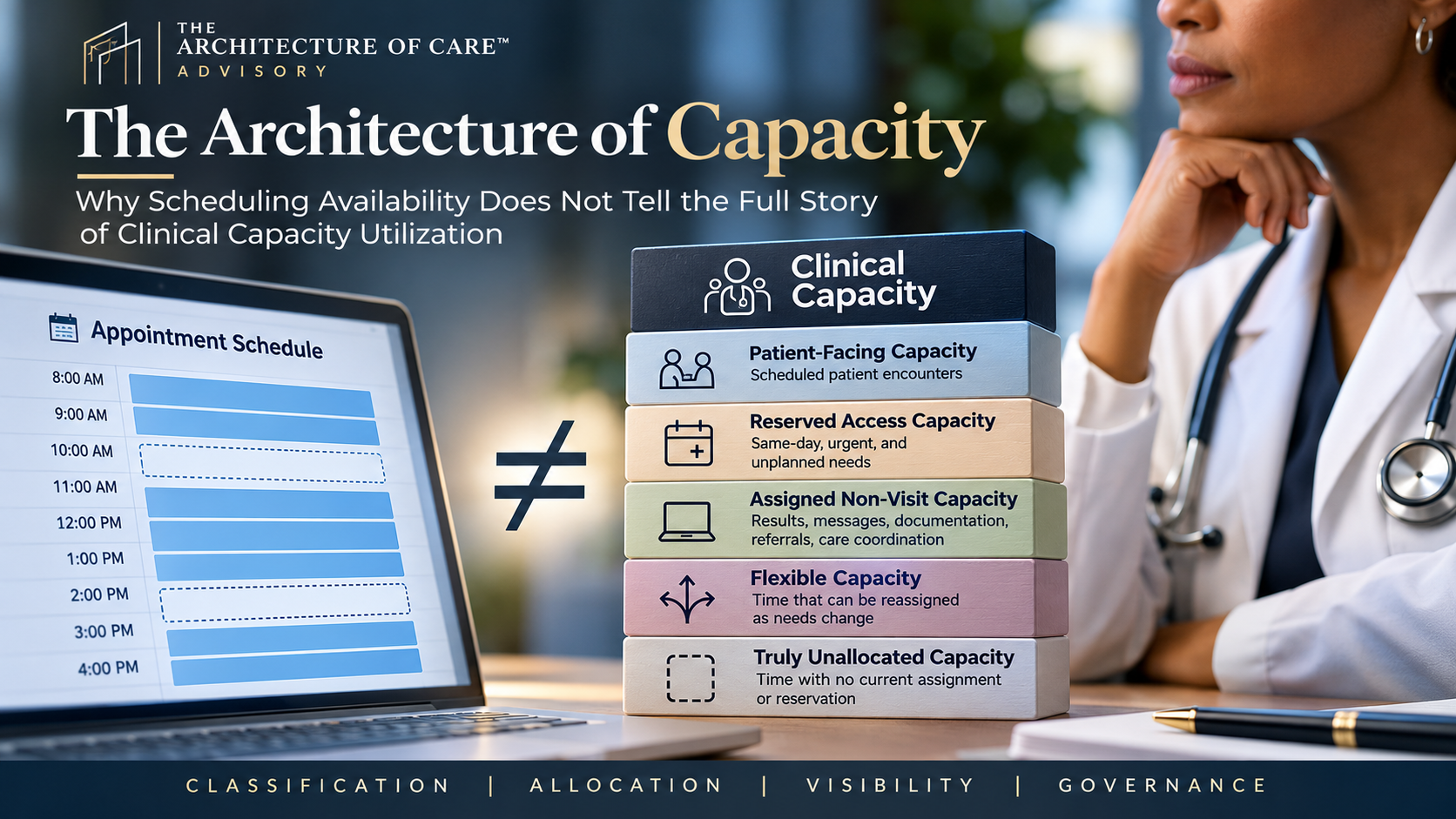

Whether the concern involves fragmented workflows, unclear accountability, constrained clinical capacity, or unreliable coordination, the starting point is a clear understanding of the operating conditions involved.
An initial executive conversation provides an opportunity to discuss the organizational challenge, relevant priorities, and whether a structured architectural assessment would be appropriate.