


Healthcare Performance Is a Systems Outcome
Healthcare organizations continue to invest in clinical technology, workforce capacity, performance measurement, and operational improvement. Yet many experience persistent challenges in access, care coordination, clinician workload, and execution reliability.
These challenges are frequently addressed through additional staffing, revised productivity expectations, new technology, or more intensive performance monitoring.
Such interventions may be necessary. However, they do not always address the structural conditions producing the underlying problem.
Healthcare performance is not determined solely by the competence of individual clinicians or the availability of organizational resources. It is shaped by how clinical work is organized, how responsibility is distributed, how information moves, and how reliably operational processes support the intended care trajectory.
Consider a specialty referral.
The referring clinician may complete the appropriate assessment and initiate the referral. The electronic health record may confirm successful transmission. From the perspective of the originating department, the task appears complete.
Yet the patient may remain without an appointment, the receiving service may lack essential information, and no clearly designated team may be responsible for identifying or resolving the delay.
Each participant may have completed an assigned task while the broader care process remains unfinished.
For executive leadership, this distinction is consequential.
Successful task completion does not necessarily constitute successful system performance.
When organizational measurement focuses primarily on individual activity rather than end-to-end execution, operational failures can remain obscured within otherwise favorable performance indicators.
The central leadership question becomes not simply whether work is being performed, but whether the organization has designed a reliable system through which that work produces its intended outcome.
The Five Structural Dimensions of Care Delivery
The Architecture of Care™ examines healthcare performance through five interconnected operational dimensions: Time, Ownership, Continuity, Information Flow, and Throughput.
Together, these dimensions provide a structured way to evaluate whether the organization’s operating model supports reliable clinical execution.
Time
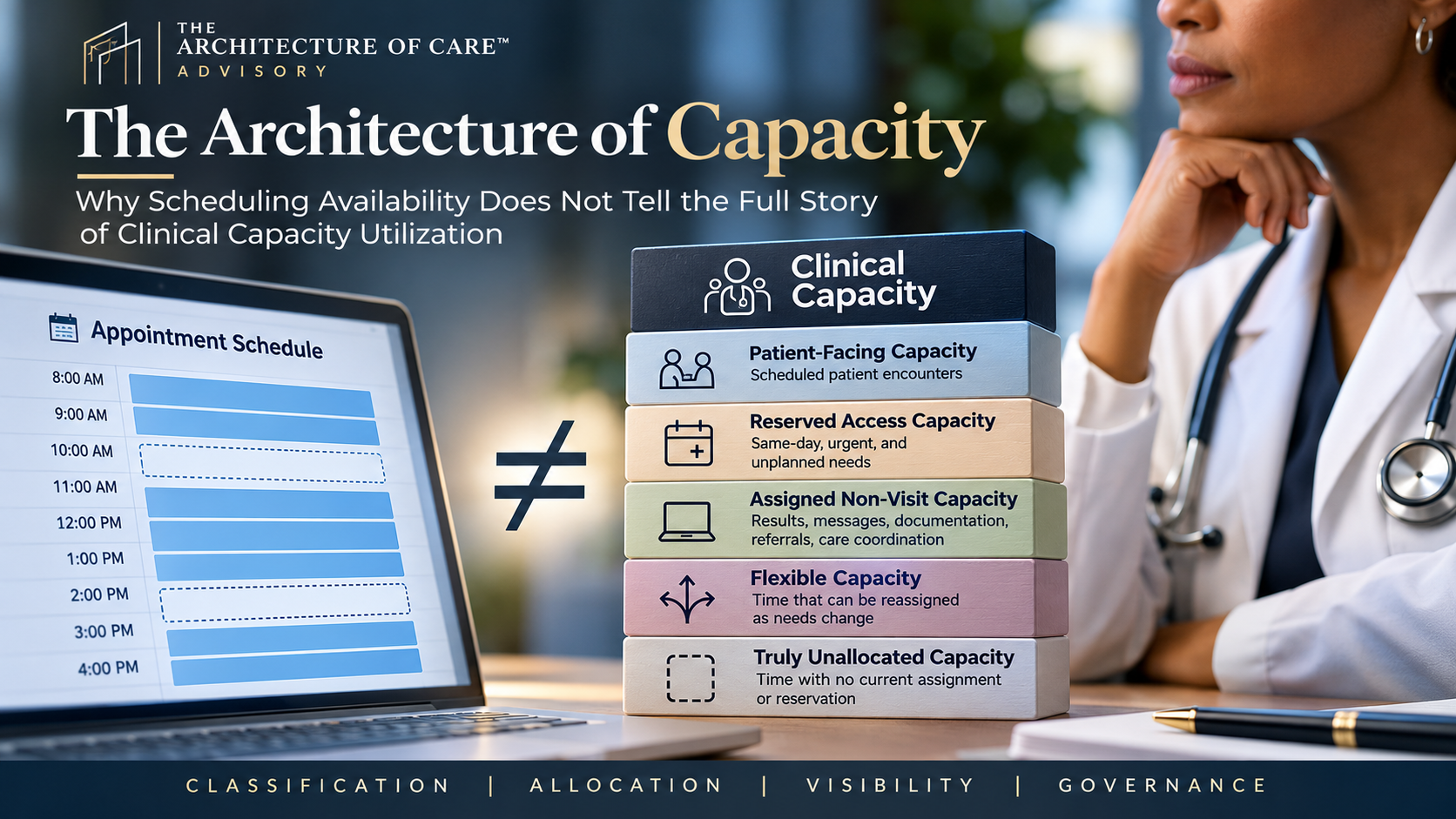
Time represents more than appointment availability or staffing hours. It includes the allocation of clinical attention, administrative capacity, decision-making time, and the resources required to complete work across the care trajectory.
When organizational expectations exceed the capacity allocated to execute them, the resulting pressure may appear as individual inefficiency rather than a structural capacity problem.
Ownership
Ownership establishes who is responsible for decisions, actions, escalation, and completion.
In complex delivery systems, responsibility can become fragmented across clinical teams, centralized departments, digital work queues, and external partners. Without explicit ownership, work may be transmitted without being accepted, monitored, or completed.
Continuity
Continuity reflects the organization's ability to preserve clinical context, responsibility, and follow-through across encounters, departments, and care settings.
It is not simply a relationship between a patient and an individual clinician. It is also an operational capability that must be supported by workflow design.
Information Flow
Information Flow concerns how clinical information is generated, transmitted, interpreted, verified, and translated into action.
The speed of information exchange is not, by itself, evidence of operational reliability. Information may reach its intended destination without triggering the necessary decision or intervention.
Throughput
Throughput describes how patients, decisions, and clinical work progress through the delivery system.
Improving throughput requires attention not only to the speed of individual activities but also to dependencies, handoffs, bottlenecks, and the conditions required for completion.
These dimensions are interdependent.
Increasing appointment availability without strengthening downstream follow-up capacity may shift rather than resolve operational constraints. Automating information delivery without clarifying ownership may accelerate the movement of unresolved work. Redistributing administrative responsibilities without preserving continuity may increase coordination demands elsewhere in the system.
For healthcare executives, the value of examining these dimensions together is the ability to distinguish isolated operational symptoms from the structural relationships producing them.

Why Operational Improvements Fail to Deliver Sustained Results
Healthcare organizations routinely pursue initiatives intended to improve access, productivity, quality, and financial performance.
These efforts may involve new scheduling models, centralized work distribution, digital automation, expanded reporting capabilities, or changes in staffing responsibilities.
The effectiveness of such initiatives depends partly on whether they address the operating conditions responsible for the original performance gap.
Consider an organization experiencing delays in diagnostic follow-up.
Leadership may introduce an automated notification system to accelerate result delivery. The technology may successfully reduce the time required to transmit information.
However, if the workflow does not establish who reviews the result, who determines the required action, how exceptions are escalated, and how completion is verified, the organization may have improved information transmission without resolving the underlying accountability risk.
The investment has improved one component of the process while leaving the end-to-end execution pathway vulnerable.
A similar pattern can occur in workforce and capacity management.
An organization may respond to low appointment utilization by increasing provider productivity expectations, even when the underlying constraint lies in scheduling access, referral routing, or patient allocation.
In such circumstances, additional performance pressure may not produce the intended improvement because the intervention targets a different part of the system from the actual constraint.
These examples illustrate a broader executive concern: operational investments can produce localized improvements without delivering proportional enterprise value.
When performance initiatives are designed around visible symptoms rather than underlying workflow relationships, organizations may experience recurring rework, duplicated responsibilities, fragmented accountability, and continued demand for additional resources.
This does not mean technology, staffing, or performance measurement are ineffective.
It means their value depends on the operating architecture into which they are introduced.
Before committing additional resources, leadership should be able to distinguish between a capacity constraint, an ownership failure, an information-flow problem, and a breakdown in continuity.
Each requires a different operational response.
The quality of the diagnosis influences the quality of the investment decision.
"Healthcare performance is shaped not only by clinical decisions, but by the systems through which care is delivered, responsibilities are assigned, and information moves."
Clinical Workflow Integrity™ as an Executive Operating Consideration
Clinical Workflow Integrity™ describes the alignment of clinical intent, operational processes, communication, information flow, responsibility, and the systems required to support reliable execution.
It provides a way to examine whether clinical work can progress from initiation to completion without depending excessively on informal workarounds, individual memory, or repeated corrective intervention.
In many healthcare organizations, operational reliability depends on activities that are only partially visible to leadership.
Clinicians reconcile incomplete information, redirect incorrectly assigned tasks, clarify ambiguous responsibilities, recover delayed referrals, and compensate for gaps between formal workflows and actual practice.
These activities may preserve care delivery in the short term.
However, when they become routine, they can conceal weaknesses in the operating model while consuming clinical capacity that is rarely reflected in conventional productivity measures.
The organization may appear to be functioning because its workforce continuously compensates for structural deficiencies.
From an executive perspective, this raises important questions.
Where does responsibility become ambiguous during a clinical process?
Which activities require repeated manual correction or clarification?
How much clinical capacity is consumed by avoidable coordination work?
Where do information systems transmit work without establishing accountability for its completion?
What happens when an intended recipient is unavailable, a task is misrouted, or a process fails?
How does the organization detect these failures, and who is responsible for recovery?
These are not merely workflow questions. They concern operational resilience, resource utilization, clinical risk, and the organization's ability to execute its care delivery strategy consistently.
Clinical Workflow Integrity™ shifts the focus from whether individual activities are completed to whether the broader system reliably connects clinical intent with operational execution.
This distinction becomes increasingly important as healthcare organizations introduce automation, expand centralized functions, and coordinate care across multiple settings.
Automation does not remove responsibility. It redistributes it.
Executive oversight must therefore consider not only what technology or organizational redesign makes possible, but also how accountability, verification, and failure recovery are preserved as work changes.
Implications for Executive Decision-Making
For healthcare leadership, sustainable operational improvement requires a clear understanding of the structural conditions influencing performance.
Traditional performance measures remain important. Access indicators, productivity data, quality metrics, financial results, and patient experience measures provide essential information about organizational outcomes.
However, these measures do not always explain why performance gaps persist or where operational interventions should be directed.
An organization may know that referral completion is delayed without understanding where responsibility becomes fragmented.
It may recognize increasing clinician workload without distinguishing direct patient care from administrative rework.
It may identify unused appointment capacity without determining whether scheduling workflows are capable of directing appropriate demand into available resources.
These distinctions matter because different structural problems require different executive decisions.
A capacity problem may require resource reallocation.
An ownership problem may require clearer decision rights and accountability.
An information-flow problem may require redesigned communication and verification processes.
A continuity problem may require stronger handoffs and longitudinal responsibility.
A throughput problem may require examination of dependencies and constraints across the entire delivery pathway.
Treating these problems as interchangeable can lead to investments that increase organizational activity without resolving the underlying performance constraint.
A more disciplined approach begins by examining how the operating model functions in practice, where work becomes vulnerable, and which structural relationships require redesign.
For executive teams, this creates an opportunity to align operational improvement with broader organizational priorities: reliable care delivery, responsible resource utilization, workforce sustainability, patient experience, and financial stewardship.
The objective is not simply to make existing workflows faster.
It is to establish the conditions under which clinical work can be completed reliably, responsibility remains clear, and operational failures can be identified and addressed before they become persistent organizational problems.
Healthcare outcomes are designed, not accidental.
The architecture through which care is delivered is therefore not a secondary administrative concern. It is a fundamental consideration in healthcare strategy, operational governance, and enterprise performance.


Whether the concern involves fragmented workflows, unclear accountability, constrained clinical capacity, or unreliable coordination, the starting point is a clear understanding of the operating conditions involved.
An initial executive conversation provides an opportunity to discuss the organizational challenge, relevant priorities, and whether a structured architectural assessment would be appropriate.